
The Suburra: What Monti Was Two Thousand Years Ago
Before it was Monti it was the Suburra: loud, crowded, flammable, and the address Julius Caesar grew up at. Most of it is still under your feet.
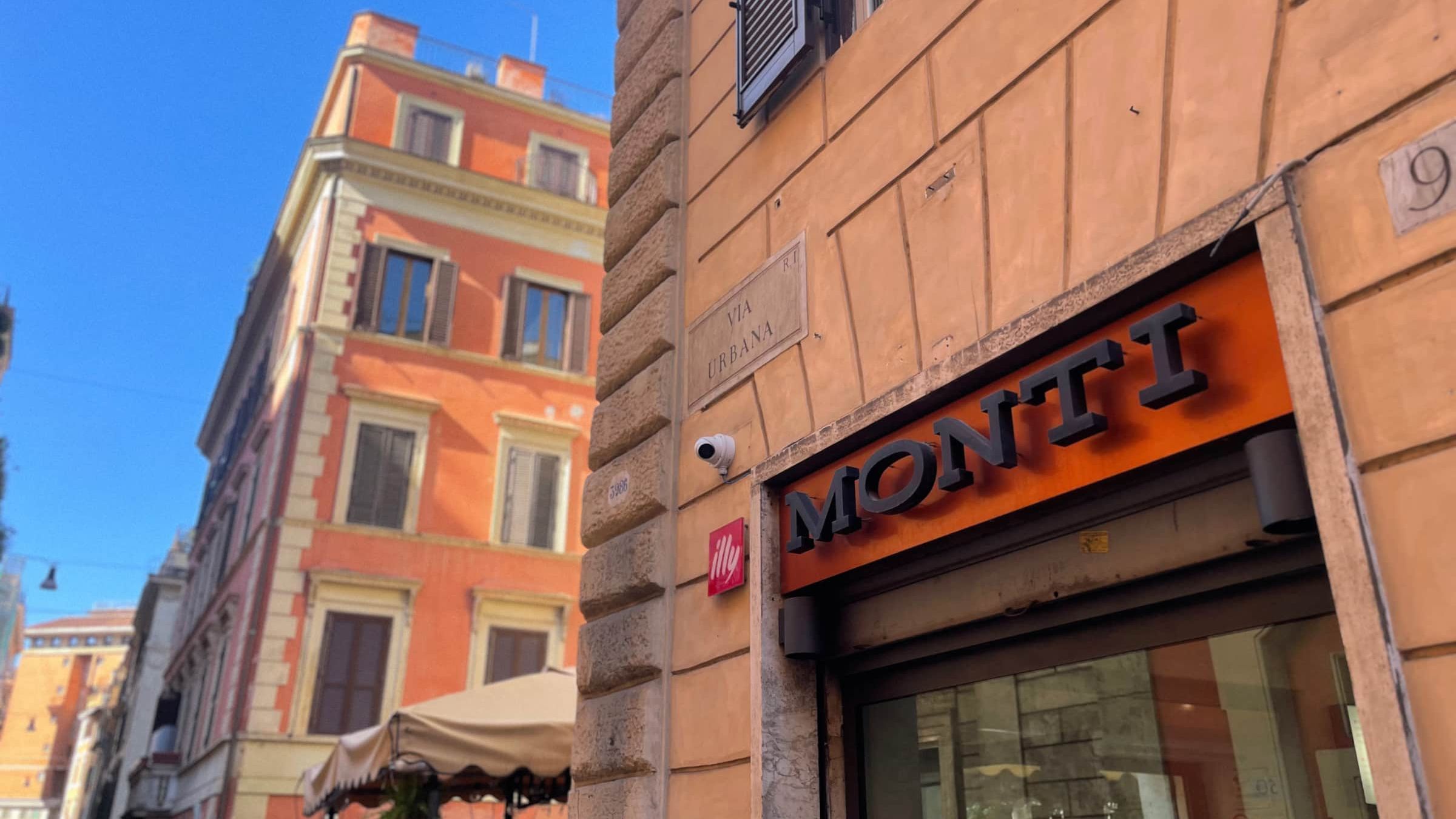
The valley our street runs through has been lived in, without a break, for longer than almost anywhere else in Europe. Not preserved. Lived in. People have been carrying their shopping home up this slope for two and a half thousand years and have never once stopped for long enough to let the place turn into a ruin. I think about that most days, usually on the third flight of stairs.
That is the thing worth understanding about Monti. The Forum, four hundred metres downhill, is an archaeological park: fenced, ticketed, finished. Monti is the part of ancient Rome that never became a museum, because people kept living in it. Which is also why there is so little of it left to see.
Where the name went
In antiquity this was the Suburra, and to a Roman of the late Republic the word carried a distinct social meaning, roughly what “the East End” or “the Lower East Side” carries now. It was the densely built valley between the Viminal, the Esquiline and the Quirinal hills, just behind the Forum. Where ordinary Rome lived.
The modern name, Monti, means “the hills”, those same hills, renamed in the medieval period when the rione system took shape. Same ground, different vocabulary, sixteen centuries apart.
What it was actually like
Uncomfortable, mostly.
Rome had somewhere around a million people at its height, packed into a city you can walk across in an afternoon, and the arithmetic only works if most of them lived stacked vertically. They lived in insulae: apartment blocks, timber-framed above the lower storeys, several floors high, built to no meaningful code and packed tight. The Suburra was full of them.
The ancient writers are consistent and unkind about it. Juvenal complains about the noise, the carts at night, the shouting. Martial writes about the smell and about being kept awake. The district was famous for three things: crowding, crime after dark, and fire.
The fire risk was not incidental. It was structural. Wooden upper floors, open flames for cooking and light, no water above the ground floor and no space between buildings. Fires in the Suburra were frequent and lethal, and the great fire of AD 64 that destroyed much of Rome tore through exactly this kind of housing.
It was also, and this matters, an ordinary place full of ordinary trades. Butchers, barbers, bakers, cobblers, and the wine shops that made the district’s reputation. It was where the city’s work was done.
And it was where a particular kind of Roman business was done too. Senators would step out of the Forum, the official stage, the place where politics was performed, and slip down into the Suburra to drink, cut deals and visit the brothels. The joke, which Romans made themselves, was that the real politics happened here rather than up there. It is the kind of joke that stops being a joke the more you look at it: the Forum was where decisions were announced, and the Suburra was where a good many of them were actually reached.
Julius Caesar lived here
The detail that reliably surprises people: Julius Caesar spent his childhood in the Suburra.
The Julii were an ancient patrician family with a genuinely grand pedigree and, at that point, not much money to go with it. So the young Caesar grew up not on the Palatine among the fashionable rich, but in a house in the crowded quarter behind the Forum, among the shopkeepers and the tenements.
It was politically useful to him later. A patrician with an impeccable name and a childhood in the Suburra could talk to the Roman crowd in a way his rivals could not, and he did, relentlessly, for the rest of his career.
What you can still see
Very little of the Suburra survives as visible ruin, for the good reason that people built over it continuously for two thousand years. But the shape of the place survives, and once you know what you are looking at, the neighbourhood becomes legible.
The street plan. Monti’s lanes do not follow the grid of a planned city, because the Suburra was never planned. They follow the contours of a valley and the property lines of people long dead. Every time a Monti street bends for no apparent reason, you are following a decision someone made before the Empire.
The slope. You feel it constantly here, and it is the original topography: the valley floor rising to the Esquiline on one side and the Quirinal on the other. Ancient Rome is not flat, and Monti is where you learn that with your legs.
The level of the ground. Rome has risen. Centuries of rubble, flood silt and rebuilding lifted the ground surface many metres above the ancient one. When you see a church or a fragment of wall sitting in a sunken courtyard below street level, that is not a basement. That is the old ground, and the street you are standing on is the accumulated debris of everything since.
The boundary wall. At the bottom of the neighbourhood, the Forum of Augustus is closed off by an enormous wall of grey stone. It was built as a firebreak, specifically to stop the fires of the Suburra from reaching the imperial forum. It is the most direct surviving statement of what the Romans thought of this neighbourhood: something to be walled off from the marble city, for safety.
Stand at that wall and you are on the exact seam between official Rome and the Rome that lived here. It has not moved.
The medieval turn
The Empire’s collapse hit this valley harder than most of the city. When the aqueducts were cut in the sixth century, the high ground of Rome became unliveable and the population collapsed toward the river, where there was water. Monti emptied out.
For centuries afterwards the rione was semi-rural: vineyards, gardens, scattered churches and monasteries among ruins. The great basilicas anchored it: Santa Maria Maggiore at the top of the hill, San Pietro in Vincoli with Michelangelo’s Moses, Santi Quattro Coronati and San Clemente further down, the latter famously stacked in three layers, a twelfth-century church on a fourth-century church on a Roman house with a Mithraic temple in it.
San Clemente is the single best thing to see if you want to understand how this ground works. You walk down through three levels and about eighteen centuries, and you can hear an underground stream still running at the bottom. It is a short walk from Monti and it will reframe everything else you look at.
The neighbourhood repopulated slowly from the Renaissance onward, and the monticiani developed a reputation for being a distinct, proud and slightly combative population, a local identity that outlasted the papal states and, in a diluted way, is still audible in how people here talk about the rest of the city.
Reading the streets
You do not need a tour for this. Walk Monti with three things in mind and it opens up.
Look at the ground level. Every sunken doorway, every church you step down into, is telling you where the old surface was.
Look for reused stone. Roman marble and travertine turns up constantly in medieval and later buildings: a column doing duty as a doorpost, an inscription upside down in a wall. Rome quarried itself for a thousand years.
Follow the water. The fountains still run, and several are on lines that are very old. Water is why the valley was inhabited and why it was abandoned.
The name came back
One last thing. The word Suburra dropped out of everyday use for centuries, and then came back in the last decade, attached to a novel, a film and a television series about organised crime in modern Rome.
So if you say the word Suburra to a Roman under forty, there is a fair chance they will think of the series rather than of Caesar’s childhood address. Both meanings attach to the same few streets, two thousand years apart, and both are about the part of Rome that quietly conducts the city’s real business somewhere behind the monuments.
That is the ground under your window. I still find it extraordinary, and I hope you will too.