
Three Days in Rome on Foot, Starting from Monti
Three days, almost no public transport, and one hard rule: never cross the city twice in a day. Built around a front door on Via Urbana.
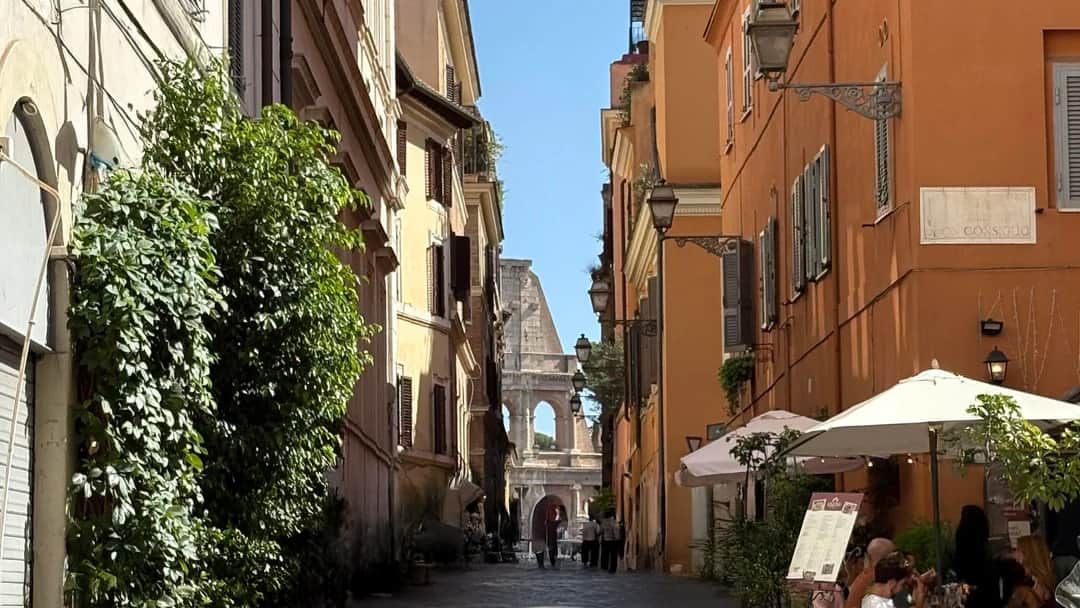
Most three-day itineraries for Rome are written by people who have never had to walk them. They put the Vatican and the Colosseum in the same afternoon, and by the second evening you are footsore, short-tempered and standing in a queue for something you no longer want to see. I have watched it happen to guests, and it always breaks my heart a little, because Rome is not a city that rewards being conquered.
So I have written the itinerary I give to friends, and it is built around one gentle constraint: you sleep in Monti, and you never cross the city twice in a day. Each day is a loop that leaves our front door and returns to it. There is a single metro ride in the whole three days, and even that one is optional. Walk it this way and Rome unfolds instead of exhausting you.
Book these before you leave home
Two things sell out. Everything else can be decided over breakfast.
The Colosseum. Standard entry is €18 and includes the Roman Forum and Palatine Hill on the same ticket. Buy it from the official site, ticketing.colosseo.it, run by the Parco Archeologico del Colosseo. Tickets are released at 9:00 Rome time exactly 30 days before the visit date, and popular slots go quickly.
If the official site shows nothing, do not panic and do not assume you are locked out. Cancellations are released continuously through the day. Third-party platforms hold separate allocations and usually have something, at a markup, from about €29 rather than €18. There are also walk-up booths at Piazza del Colosseo, which is a gamble in high season and often fine in February.
The Vatican Museums. Book a timed entry directly with the museums. This is the one where turning up hopefully in July is a genuinely bad idea.
Prices and booking rules checked 17 August 2026.
Everything else, churches, piazzas and the whole of day three, needs no ticket.
Day one: the ancient city, downhill
The great advantage of sleeping in Monti is that the classical core is below you. You walk down into it.
Morning. Start at the Colosseum with an early slot. Early matters more than any other decision on this trip: the light is better, the heat has not arrived, and the crowd is a fraction of what it will be by eleven.
Then walk straight into the Roman Forum and Palatine Hill on the same ticket. Give this more time than you think. The Forum is confusing and it rewards slowness. Climb the Palatine for the view down into it; that is where the whole thing finally makes sense as a place rather than a field of stones.
Lunch. Come back up into Monti. Ten minutes uphill and the prices halve, because you have crossed out of the monument zone into a neighbourhood.
Afternoon. Two options within a few minutes’ walk, depending on how much you have left.
- San Pietro in Vincoli for Michelangelo’s Moses. Free, usually calm, and one of the most extraordinary things in Rome that people walk past.
- San Clemente, slightly further downhill: a twelfth-century church built on a fourth-century church built on a Roman house with a Mithraic temple in the basement. You descend through three layers and eighteen centuries, and there is still water running at the bottom. If you see one thing that is not on the standard list, see this.
Evening. Stay in Monti. You have earned not going anywhere, and the neighbourhood is at its best around Piazza della Madonna dei Monti in the early evening.
Day two: the Baroque centre, westward
Today is a loop west through the Centro Storico and back. It is flat, it is all on foot, and it takes as long as you let it.
Morning. Leave Monti heading west, past the Quirinale, and arrive at the Trevi Fountain as early as you can stand. By ten it is shoulder to shoulder. At half past seven it is one of the great sights of Europe and you will have it nearly to yourself.
Continue to the Pantheon, still, after nineteen centuries, the thing that most reliably stops people mid-sentence. Then Piazza Navona, which is Bernini and Borromini arguing across a Baroque square built on the shape of a Roman stadium.
Lunch. Step two streets off any of these piazzas before you eat. The rule in central Rome is mechanical: restaurants with a view of a monument charge for the view, and the food follows the price down.
Afternoon. Options, pick one:
- Campo de’ Fiori and the streets around it, for the market in the morning and the bookshops afterwards.
- The Capitoline Museums on the Campidoglio, the oldest public museums in the world, with the she-wolf, the Marcus Aurelius, and a view over the Forum from the back that is better than most of the paid viewpoints.
- Piazza di Spagna and the Spanish Steps, if you want the postcard. Honest assessment: it is crowded, it is a staircase, and it is the least rewarding hour of the three days.
Evening. Walk back east into Monti as the light goes. The route past the Imperial Fora at dusk, lit, with far fewer people than in daylight, is the best free thing in the city.
Day three: across the river, or not at all
This is the day with a real choice, and it depends on what kind of traveller you are.
Option A: the Vatican
If it is your first time in Rome, you go. St Peter’s Basilica is free and vast; the Vatican Museums and the Sistine Chapel are ticketed and enormous.
Be realistic. The Vatican is not a morning, it is a day, and it is the one part of this itinerary that breaks the walking rule. It is a genuine journey from Monti, so take the metro or a bus rather than pretending otherwise. Go early, accept that the museums are a slow-moving river of people, and do not schedule anything demanding for the afternoon.
Option B: Trastevere and the Janiculum
If you have seen the Vatican, or you would rather end the trip on a good mood than a monument, cross the river to Trastevere instead. Lanes, ivy, the gold mosaics of Santa Maria in Trastevere, and then the climb up the Janiculum for the view back over everything you have walked for two days. It is the single best panorama in Rome and it is free.
Option C: stay in Monti
Nobody writes this one down, and for a certain kind of visitor it is the right answer. Monti’s own streets, Via del Boschetto, Via Panisperna, Via dei Serpenti and our own Via Urbana, carry independent shops, vintage, ceramics and studios. A last day spent buying things you will actually keep, eating a long lunch, and going back for a nap is not a wasted day in Rome. It is what living here is like.
How to not ruin it
Go early or go late. Rome between eleven and four in summer is a heat and crowd problem. Romans have known this for two thousand years and structure the day around it. Follow them.
One major site a day. Two is possible and you will remember neither.
Cover your shoulders and knees for churches. This is enforced, including at St Peter’s, and being turned away at the door after a long walk is a bad twenty minutes.
Drink from the fountains. The little cast-iron street fountains, the nasoni, run constantly with cold, clean, free drinking water. Block the spout with a finger and it arcs upward. Carry a bottle and refill it; buying water in central Rome is a tax on not knowing this.
Wear real shoes. The streets are sampietrini: small basalt cobbles, uneven, polished slippery by centuries. They are beautiful, and they punish thin soles and any heel at all.
Book dinner, or eat early. Romans eat late. A good restaurant at half past eight without a booking is optimistic; the same place at seven usually has a table.
What this looks like from Via Urbana
Every day above starts and ends at the same front door. Day one goes downhill and comes back up. Day two goes west and loops home. Day three crosses the river, or does not.
That, in the end, is why I live in Monti and why I recommend it without hesitation. Not because it is prettier than Trastevere, though on certain evenings I would argue that too, and not because it is more central than the Pantheon. It is because this is the point in Rome from which the least walking gives you the most city, and because at the end of a very long day you come home to a neighbourhood, up a cobbled street, past people who are having dinner outside, without ever having to plan the journey back.